
Surprising fact to start: most browser wallets still rely on users to mentally simulate the effects of a transaction — even when the cost of a mistake can be hundreds or thousands of dollars. Rabby Wallet deliberately rejects that norm by simulating transactions and scanning for risks before you click “confirm.” For DeFi power users in the US who move assets across chains, interact with composable protocols, or manage institutional multisig setups, that difference is not cosmetic. It changes the failure modes you need to defend against.
This article compares Rabby with two common alternatives — MetaMask and Coinbase Wallet — and explains the mechanisms behind the claim that pre-signing simulation and automatic network switching reduce “blind signing.” I’ll show where Rabby’s design choices buy safety and convenience, where they impose limits or trade-offs, and what to watch for next when adopting it as your primary multi-chain tool.
How Rabby’s approach works (mechanisms, not marketing)
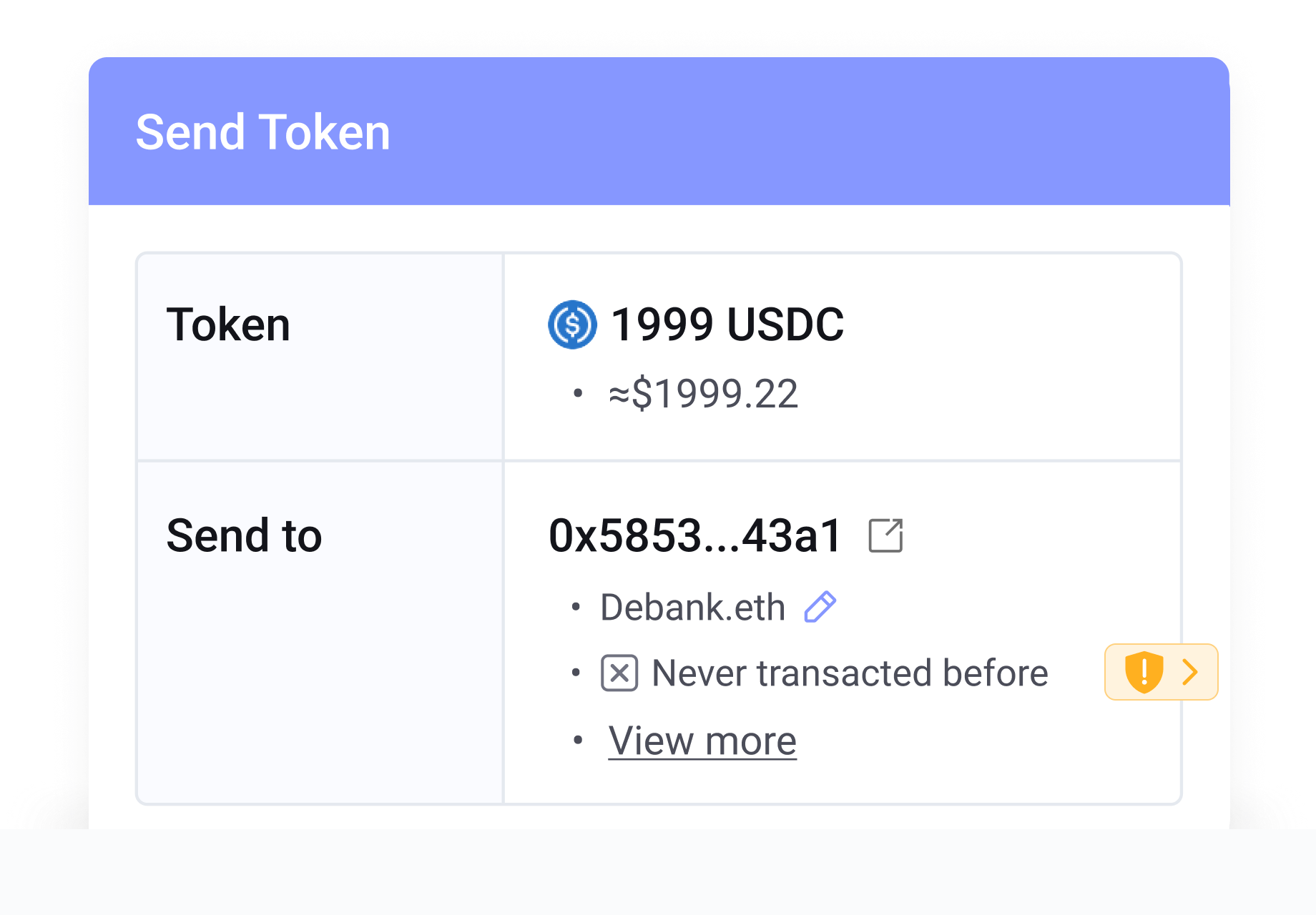
At the technical level, Rabby intercepts the transaction payload a dApp asks the wallet to sign, reconstructs the state change that payload implies (token transfers, approvals, swaps, fees), and displays an explicit, line-item preview: estimated token balance changes plus the gas cost. That’s transaction simulation. In parallel, a security engine scans the target contract and involved addresses against heuristics and known red flags — previously exploited contracts, suspicious approval patterns, or nonexistent recipient addresses — and surfaces warnings.
Automatic network switching is a separate but related convenience: when you load a dApp that expects you to be on Arbitrum, Rabby will detect the chain and switch the wallet context automatically. The combination reduces two common human errors: signing the wrong action (blind signing) and attempting a transaction on the wrong chain (insufficient gas or failed calls).
Side-by-side trade-offs: Rabby, MetaMask, and Coinbase Wallet
Three practical dimensions matter for a DeFi power user: security controls (pre-sign protection, revocations, hardware compatibility), composability (multichain support and dApp ergonomics), and operational limits (fiat on-ramps, staking, integration with institutional tooling).
Rabby: strong on pre-sign protections and operational multi-chain ergonomics. Built-in transaction simulation and pre-transaction risk scanning lower the probability of blind-sign losses. Native approval revocation tools let users inspect and cancel active approvals without leaving the wallet — a small but high-value operational control. Rabby also integrates with enterprise tools and multisig solutions like Gnosis Safe and Fireblocks, and supports hardware devices such as Ledger and Trezor, which preserves cold-key security while using the simulation features.
MetaMask: ubiquitous and broadly supported by dApps, with deep ecosystem integrations and high familiarity for users. It lacks out-of-the-box transaction simulation like Rabby’s and therefore still places a higher cognitive burden on the signer to verify intent. MetaMask’s ubiquity means fewer compatibility surprises, but ubiquity is not the same as superior safety mechanisms.
Coinbase Wallet: friendly UX and easier onboarding for less technical users, and stronger fiat rails through the Coinbase ecosystem when custody is acceptable. It is convenient but less focused on pre-sign safety engineering. For power users who need detailed transaction previews and explicit revocation tooling, Coinbase Wallet is less feature-rich than Rabby.
Where Rabby meaningfully reduces risk — and where it doesn't
Rabby’s simulation helps prevent “blind signing,” a class of risk where a malicious or buggy contract asks a user to approve operations the user didn’t intend. By showing exact token deltas and fee estimates, Rabby turns a probabilistic guess into a visible outcome. The revocation tool reduces long-lived exposure from token approvals, which are a common vector for hacks.
But simulation is not a silver bullet. It depends on accurate on-chain state and correct decoding of complex contract logic. Sophisticated scams can obfuscate intent in ways that evade heuristics, and zero-day vulnerabilities in dApps or third-party services can still cause losses after users correctly interpret a simulated transaction. Rabby’s historical incident — a Rabby Swap contract exploit in 2022 — is a reminder that wallet-level defenses reduce, but do not eliminate, protocol-level risks. The team froze the contract and compensated users, and they tightened audits; this sequence shows remediation is possible but not instantaneous.
Operational trade-offs and limitations to accept up front
If you choose Rabby as your primary wallet, acknowledge two pragmatic constraints. First, it currently lacks a built-in fiat on-ramp: you cannot buy ETH or USDC with a bank card inside the wallet UI. That matters in the US because regulatory-friendly on-ramps can simplify compliance and tax reporting for some users; you’ll need to use an external exchange or custodial onboarding pathway. Second, Rabby does not provide native staking inside the wallet, so long-term yield strategies and validator interactions require separate tooling.
Another practical trade-off is complexity of features. Power users benefit from transaction simulations and revocation tools, but beginners may find the extra warnings and screens unfamiliar. Rabby mitigates this with a polished UI and a “Flip” toggle that lets users switch between Rabby and MetaMask defaults — a pragmatic bootstrapping aid that reduces friction for teams transitioning tools.
Decision framework: when Rabby is the right choice
Use this heuristic: if you routinely (a) sign complex interactions (swaps, router approvals, permit flows), (b) move assets across multiple EVM chains, or (c) operate with institutional or multisig custody, Rabby’s combination of simulation, approval revocation, automatic network switching, and hardware-wallet compatibility materially reduces operational risk. For single-chain users who primarily receive tokens or use simple transfers, the marginal benefit is smaller and ecosystem ubiquity (MetaMask) or fiat convenience (Coinbase Wallet) may be more practical.
Another decision rule: if your workflow includes cross-chain gas top-ups — for example, you need to ensure an account on a secondary chain has gas to complete a transaction — Rabby’s built-in gas top-up tool simplifies recovery and keeps multi-chain operations fluid.
Practical checklist to evaluate before adopting Rabby
1) Confirm hardware wallet compatibility for your device model and practice using the combination of Rabby + hardware device in a small test transaction. 2) Map your common dApps and verify Rabby’s automatic network switching behaves as expected — some niche dApps still rely on manual RPCs. 3) Run an approval audit inside Rabby and revoke any approvals you don’t actively need. 4) Prepare an off-wallet fiat onboarding plan if you need USD <> crypto rails in the US.
For a straightforward way to get started with the extension and test simulation locally, see the rabby wallet extension for the browser — it’s an easy entry point for power users who want to compare transaction previews side-by-side with MetaMask. rabby wallet extension
What to watch next — conditional signals, not promises
Key signals that would change the calculus: broader adoption of pre-sign transaction simulation across wallets (which would make Rabby’s advantage less unique); deeper integration of fiat on-ramps into open wallets (lowering the need for exchanges); and, crucially, the frequency and severity of future protocol-level exploits. If audits and formal verification tools for complex DeFi contracts become more mainstream, wallet-level simulations will shift from “preventing naive mistakes” to “verifying complex contract semantics,” and that would increase the value of simulation-capable wallets.
Conversely, regulatory friction in the US around custodial services or on-ramp plugins could make wallets that rely on external exchanges more cumbersome. That would favor non-custodial wallets with strong tooling for managing approvals and multisig integrations.
FAQ
Does Rabby prevent all kinds of smart-contract exploits?
No. Rabby’s simulation and pre-transaction scanning reduce the chance of blind-sign mistakes and alert you to known red flags, but they cannot prevent protocol-level vulnerabilities, zero-day exploits, or governance attacks. Wallet-level defenses change your failure modes; they do not eliminate systemic risk in DeFi.
Can I use Rabby with a hardware wallet?
Yes. Rabby integrates with common hardware devices — Ledger, Trezor, Keystone, and more — so you can keep private keys offline while still benefiting from transaction previews and revocation tools. Always test the hardware + extension flow with a small transfer before moving large balances.
What about multisig or institutional setups?
Rabby integrates with multi-signature and enterprise custody solutions like Gnosis Safe and Fireblocks, which makes it reasonable for small institutional use. For larger institutions, combine Rabby’s UX with firm-level policy, audits, and on-chain monitoring tools rather than relying on the wallet alone.
Is Rabby open source and auditable?
Yes. Rabby is released under an MIT license and its codebase is available for independent review, which increases transparency and allows third-party security firms to audit the implementation. Open-source status reduces but does not remove risk — audits must be maintained as software and protocols evolve.


